Red Rising
by Pierce Brown
Info
New Cover
A Few Thoughts
On the cover of Pierce Brown's Red Rising, a blurb states "Ender, Katniss, and now Darrow." And yes, Red Rising does exactly what it says on the tin.
Darrow, the protagonist of Red Rising, is just as much of a Gary Stu as Ender. He's smarter, stronger, and morally better than everyone else. If he does something bad, it's not necessarily his fault; he's been led there by the system. And the conflict of the story is so similar to The Hunger Games that I actually tapped out halfway through my first attempt to read/listen to Red Rising years ago.
But the Red Rising trilogy and its sequel trilogy have been perhaps my most consistently recommended books. So, I gave it another shot. And upon finishing, I think Red Rising should be considered just as good as (potentially better than?) the Ender series and The Hunger Games.
Brown is clearly trying to capitalize on the young adult fiction trend in the early 2010s. Children thrown into life-and-death circumstances. A world that's structurally unfair. A tragic opening act. It's a formula, but it's a formula because it works.
This time, we're in a far future where humanity has settled the entire solar system. To do so, the ruling class enforces genetic modification, stratifying society into castes marked by hair and eye color. Each color has its role. Reds are miners. Greys are cops. Coppers are bureaucrats. Golds are rulers.
A resistance movement rescues Darrow, a Red, and recruits him to infiltrate an elite school for Golds. Once there, he makes friends, enemies, and perhaps sparks the beginning of a revolution.
Two things stood out to me on this listen.
First, the phrase "red rising" combined with an oppressed working class and Darrow's prominent sickle (sorry, slingblade) symbol obviously evokes Soviet iconography. But I can't quite put my finger on what Brown is trying to say with these motifs. Golds (capitalists?) say they're meritocratic, but cheat and always will. Resistance is formed by cross-color/class cooperation and solidarity...?
Second is race. In Red Rising, Brown constructs an explicit class system based on the color of a person's hair and eyes. Pink, Purple, Blue, Green, Gold, Red, etc. I can't tell if there's anything deeper there Brown is trying to say besides, "Hey, wouldn't this suck?" And "We shouldn't judge people by their appearance or heritage?" I mean, yes. Of course. It's an important message in a young adult book. But is... that it...?
I'm definitely going to keep reading. I want to see where Brown takes this story, if he can grow out of the tropes, and if these themes get explored in a deeper way.
Related:
Cover Notes
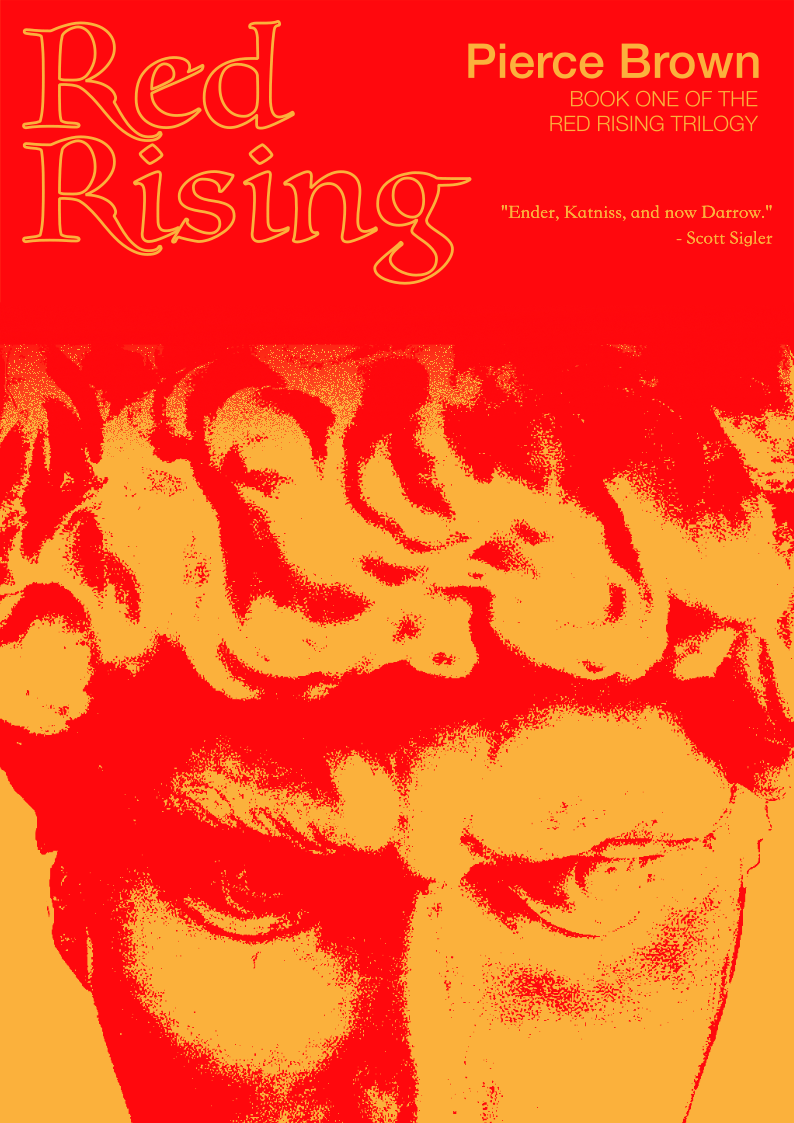
I kept this one simple as I had this idea of a duo-tone design from the get-go based on this image. I took this photo of a Roman statue and did some thresholding and distressing. Then I applied the colors. Most of the time was spent wrestling with GIMP's aliasing funkiness.


Previously On Cover2Cover
August
Morning Star ᛫ Haiku in English The First Hundred Years ᛫ Golden Son ᛫ Blood Meridian ᛫ Bat Kid ᛫ Igaguri ᛫ Best Served Cold
July
June
Cloud Atlas ᛫ Do Androids Dream of Electric Sheep ᛫ Piranesi ᛫ The One Hand and The Six Fingers
May
Hobbit Virtues ᛫ Last Argument of Kings ᛫ The Tomb
April
The Wrestler ᛫ Before They Are Hanged ᛫ The Blade Itself ᛫ Abhorsen ᛫ Pet Semetary ᛫ An Invitation from a Crab
March
February
Words of Radiance ᛫ The Carrier Bag Theory of Fiction ᛫ Lirael
January
The End of Burnout ᛫ The Sword of Shannara ᛫ Enshittification ᛫ Ubik ᛫ The Way of Kings