Best Served Cold
by Joe Abercrombie
Info
New Cover
A Few Thoughts
In a 2009 interview at the end of Best Served Cold, the interviewer asks author Joe Abercrombie how he feels about being “one of the main progenitors of the sub-genre known as ‘scoundrel-lit.’” Abercrombie disagrees, preferring to call it "unheroic fantasy," and lists authors who have been writing in this style for decades, including George R.R. Martin and Jack Vance.
That answer helped me understand what exactly it is about Abercrombie's writing that works so well for me. It's unapologetically campy and uses that camp to explore un-campy things. How well do you really know those you love? When people change, is it gradual or all at once? How much can they change, really?
Gene Wolfe, a deep admirer of Vance, is perhaps my favorite author. He also uses camp and writes often about "unheroes." Abercrombie, in my opinion, is not on the level of Wolfe, but he's doing similar things.
First, a simple premise to explore a very complex world. Best Served Cold, as its unoriginal, campy name suggests, starts as a simple revenge story. Mercenary general Monza Murcatto's employer betrays her, murders her brother in front of her eyes, and stabs her, chokes her, and shoves her off a cliff. She survives and, naturally, hatches a plan for vengeance.
Seven betrayers to kill, a team of seven revengers, and seven set pieces. Each set piece contains one plan for vengeance, explores the Renaissance-Italy-inspired setting, and drops breadcrumbs of the almost incomprehensibly large geopolitical game going on in the background.
Plans go awry, teammates butt heads, and larger powers get involved, unraveling what was a simple revenge story.
Second, unflinching portrayals of violence. Abercrombie seems to take pleasure in explaining, in detail, what it would feel like to, for instance, stave someone's head in with a mace. Not to mention how tiring that act would be. And what it would look like after.
These gruesome descriptions exist for a reason (most of the time). They're a reminder that the characters you're following are not good people, and these are not good times. And, by the way, isn't it a little weird that so much of modern epic fantasy just kind of glosses over or even glorifies this kind of violence?
There is no glory in the violence Abercrombie depicts. These aren't superhero action figures he's mashing together (cough SANDERSON cough). These are people made of flesh and blood doing their best to deprive others of the same.
Third, limited character perspectives "hiding" important reveals. One thing I like about Martin, Wolfe, and now Abercrombie is that you can foresee their campy twists if you're reading closely. The reason they may seem "hidden" is limited character perspective.
Some of these people are kind of dumb! They miss things, especially when it comes to people they love. But if you read between the lines, you'll get a decent idea of what's really going on.
Fourth, "unheroes." None of the characters in this book are redeemable, but they're lovable in their own way. Cosca, the drunken, almost supernaturally lucky trickster on a path to sober up finally...? Shivers, the fish-out-of-water brute from the north trying to make a life for himself outside the only thing he knows: violence. Watching these people interact is endlessly entertaining.
Best Served Cold is a standalone book, so you don't have to read the full First Law trilogy beforehand. But there are so many little Easter eggs and returning side characters (who each get their time in the limelight) that I recommend reading this book as the fourth in the series.
I recommend Best Served Cold if you share my tastes, but it's not for the squeamish.
Related:
Cover Notes
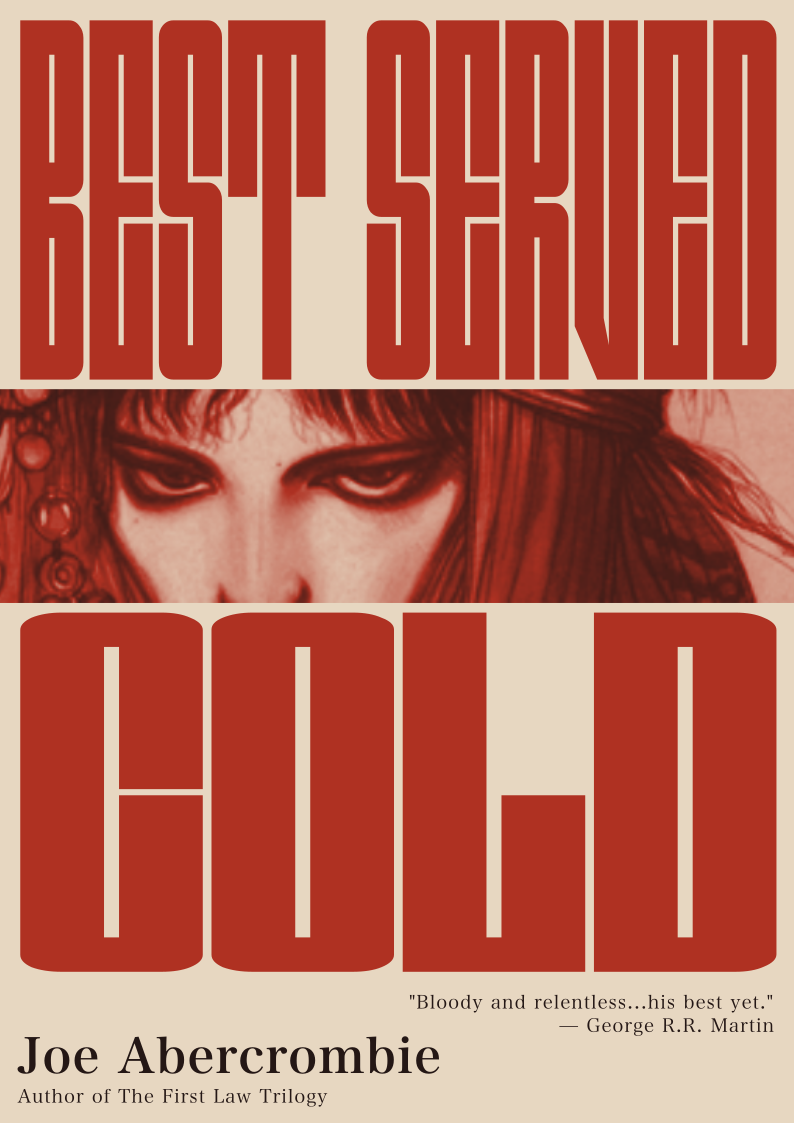
This was a fun one because I got to try out a few tools I've been looking forward to. The typeface is Outward by Raoul Audouin. Distributed by velvetyne.fr. And I cropped this illustration I found by Yoshitaka Amano for Guin Saga for the representation of Monza. Then, I manipulated it a bit using this site with some cool free tools.

Previously On Cover2Cover
August
Morning Star ᛫ Haiku in English The First Hundred Years ᛫ Golden Son ᛫ Blood Meridian ᛫ Bat Kid ᛫ Igaguri ᛫ Best Served Cold
July
June
Cloud Atlas ᛫ Do Androids Dream of Electric Sheep ᛫ Piranesi ᛫ The One Hand and The Six Fingers
May
Hobbit Virtues ᛫ Last Argument of Kings ᛫ The Tomb
April
The Wrestler ᛫ Before They Are Hanged ᛫ The Blade Itself ᛫ Abhorsen ᛫ Pet Semetary ᛫ An Invitation from a Crab
March
February
Words of Radiance ᛫ The Carrier Bag Theory of Fiction ᛫ Lirael
January
The End of Burnout ᛫ The Sword of Shannara ᛫ Enshittification ᛫ Ubik ᛫ The Way of Kings