Bat Kid
by Inoue Kazuo
Info
New Cover
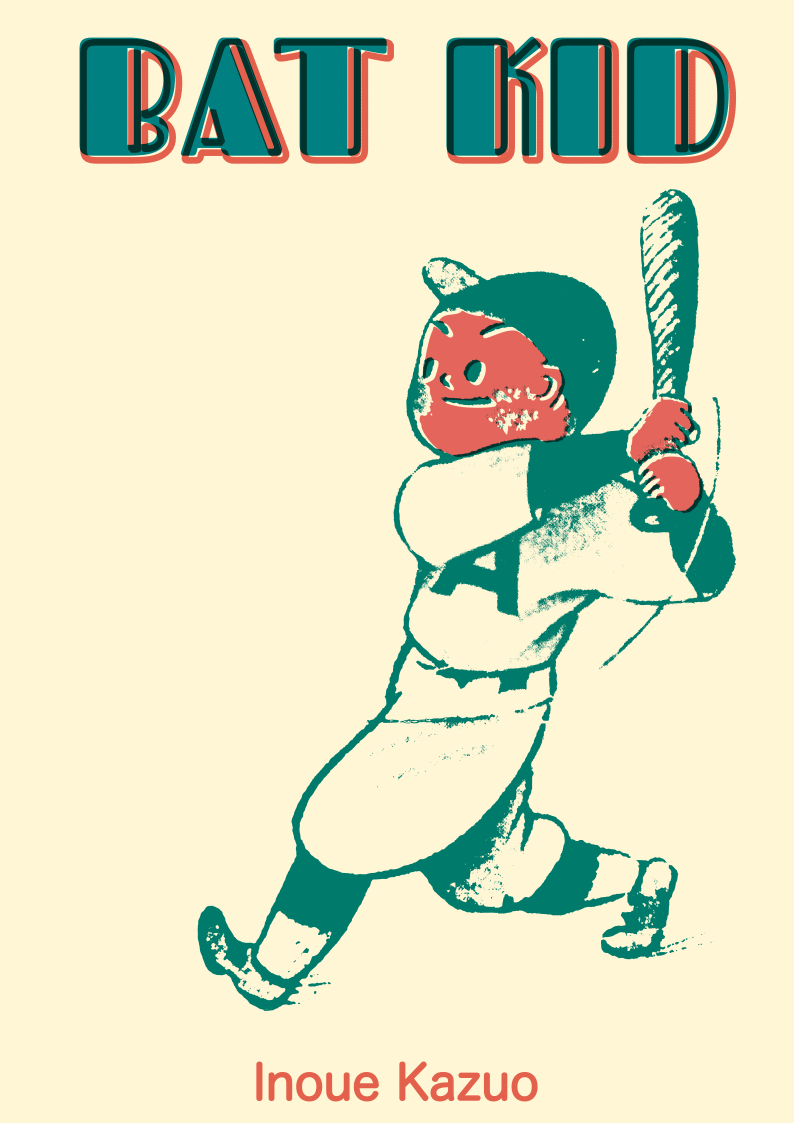
A Few Thoughts
Bat Kid is just a nice little comic about a kid joining a baseball team. I bought it at the same time as Igaguri, both put out by Bubbles Zine and translated by Ryan Holmberg. And, just like Igaguri, it gave me a sense of vertigo. Bat Kid author Inoue Kazuo, like Igaguri author Fukui Eiichi, died young at age 34 (the age I am as I write this) due to a stroke likely induced by overwork.
Holmberg's introductory essay focuses on the history of baseball in Japan and explains that, while it's not the first, Bat Kid could be considered the most influential baseball manga. A couple of his sources outright say that modern manga would not be the same without it.
In its early years, Bat Kid was such a hit that it helped keep a fledgling comics magazine afloat. That magazine, and others that followed, later housed blockbuster manga by Tezuka Osamu (creator of Astro Boy) and Fukui Eiichi.
Heck, Fukui himself (who was a few years younger than Inoue) got his start in comics by helping to continue Bat Kid after Inoue's death. Bat Kid also started a trend where children who grew up reading sports manga later became professional athletes. Haikyu!! is one recent manga that comes to mind. It led to a sharp increase in participation in boys' volleyball.
As a progenitor of future manga, Bat Kid is pretty unassuming. It's a small, cozy story about a kid scrounging up enough money to buy his first bat or missing a pop fly catch in the outfield and learning to get back up and try again.
What I can't stop thinking about, though, is how young Inoue and Fukui both were when they died. Both had other health complications. Fukui had an undiagnosed heart condition. Inoue had an outer tissue infection in his lungs for most of his childhood, leaving him bedridden.
While ill, he entertained himself and his sisters with illustrations and riddles. He would often submit his work to the comics magazines he read, and these magazines would occasionally publish him in the amateur section. Eventually, he got called up by one of the editors to become a full-time contributor.
Inoue's illustration style and humor were sought after, as they combined Western styles (e.g., Disney and Popeye) with Japanese values. It was good clean fun parents could feel okay about their kids reading.
This success was a double-edged sword. Inoue juggled many projects at once, and the stress, combined with his history of illness, led to a stroke that he didn't recover from. After another stroke, he passed away.
Holmberg quotes Inoue's sister, and from her comments, it sounds like Inoue and his family knew he'd live a short life. She expresses deep joy that, with the time he was given, Inoue entertained a whole generation of kids in post-war Japan.
Both Inoue and Fukui were so accomplished but at such a high cost. They were both younger than me when they died. And people, like me, are still reading their work.
Related:
Cover Notes
Did the exact same process as I did with Igaguri!
Previously On Cover2Cover
August
Morning Star ᛫ Haiku in English The First Hundred Years ᛫ Golden Son ᛫ Blood Meridian ᛫ Bat Kid ᛫ Igaguri ᛫ Best Served Cold
July
June
Cloud Atlas ᛫ Do Androids Dream of Electric Sheep ᛫ Piranesi ᛫ The One Hand and The Six Fingers
May
Hobbit Virtues ᛫ Last Argument of Kings ᛫ The Tomb
April
The Wrestler ᛫ Before They Are Hanged ᛫ The Blade Itself ᛫ Abhorsen ᛫ Pet Semetary ᛫ An Invitation from a Crab
March
February
Words of Radiance ᛫ The Carrier Bag Theory of Fiction ᛫ Lirael
January
The End of Burnout ᛫ The Sword of Shannara ᛫ Enshittification ᛫ Ubik ᛫ The Way of Kings