Cloud Atlas
by David Mitchell
Info
New Cover
A Few Thoughts
I first watched the Cloud Atlas movie while studying abroad in Taiwan as a way for our professor to introduce basic Buddhist concepts, like Samsara. I didn't understand all of it at the time, but I knew the story was conveying, or at least attempting to convey, big ideas.
So, the Cloud Atlas book always loomed over my "To Read List" as a Big Idea Book for Smart People Who Think Good™. But, in listening to it (which I'm not sure I totally recommend except for one section), it fell flat.
The book itself feels more like an experiment in form rather than a profound tome of wisdom. As he explains in his afterword, Mitchell used a A1, B1, C1, D1, E1, F, E2, D2, C2, B2, A2 structure for Cloud Atlas.
And he writes each story in a different mode: a diary, a pulpy thriller, an interrogation, a story around a campfire. It's entertaining, but a LOT to hold in your head.
So, when Mitchell tries to drive a philosophical point home, there is no subtlety. There's simply no room for nuance.
Helping others is the same as helping yourself. Just because you can't conceive of a world beyond the present doesn't mean it can't exist. The drop of water in an ocean line at the end, while profound, is a riff on an idea I've read and heard from Alan Watts many times.
These ideas are worthwhile, just conveyed in an uninteresting way. It felt almost like a pause in the middle of the show to turn and say to the audience something like, "It's important to learn to forgive yourself."
Each story is NOT created equal. Sonmi's story drags (the E sections) while Zachry's story (the F section), which is an oral history, grips you from sentence one and doesn't let you go.
Parts of Cloud Atlas I'll never forget. Others I already have. Weird book overall, but worth a read. Make time to listen to Sloosha's Crossin' an' Ev'rythin' After (i.e., Zachry's story). I feel like that section, at least, is meant to be heard, not read.
Anyways, I'm off to watch the movie again!
Cover Notes
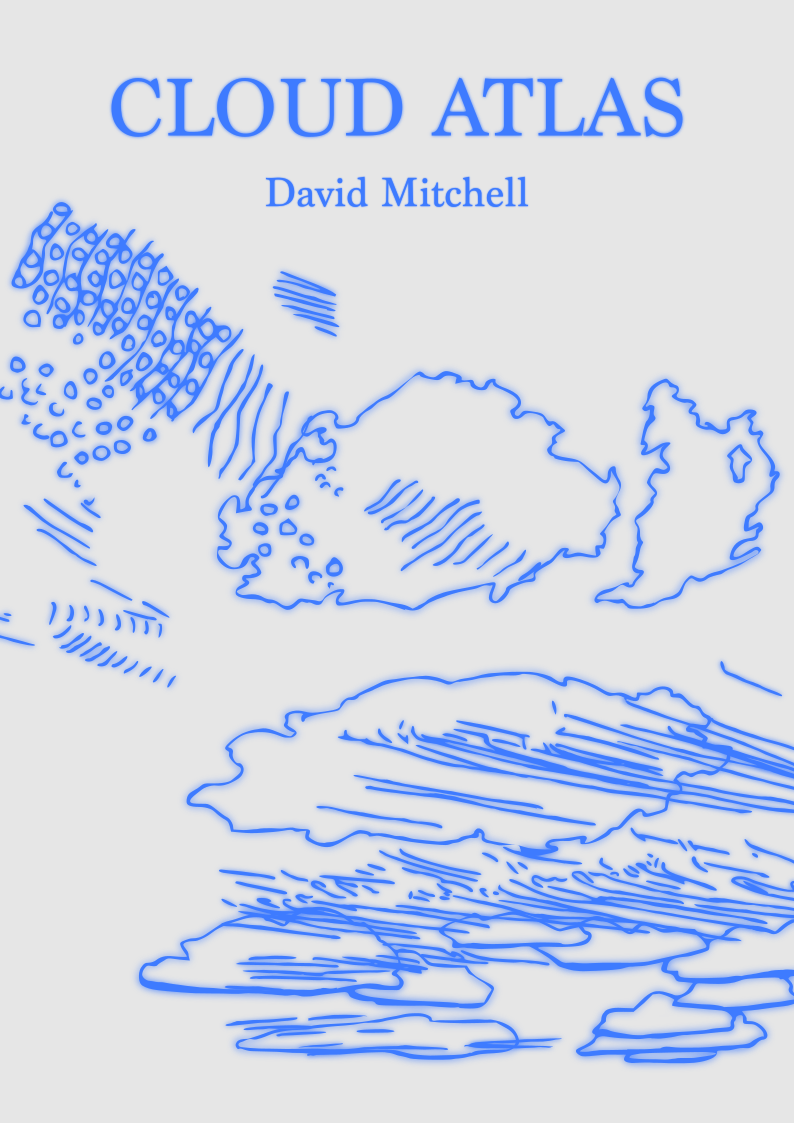
I found these cloud illustrations on are.na by searching "cloud atlas." So, I decided to trace parts of them and overlay each to show the overlapping nature of the study. Pretty fun! But ran out of time, I wanted to find some more.
Previously On Cover2Cover
August
Morning Star ᛫ Haiku in English The First Hundred Years ᛫ Golden Son ᛫ Blood Meridian ᛫ Bat Kid ᛫ Igaguri ᛫ Best Served Cold
July
June
Cloud Atlas ᛫ Do Androids Dream of Electric Sheep ᛫ Piranesi ᛫ The One Hand and The Six Fingers
May
Hobbit Virtues ᛫ Last Argument of Kings ᛫ The Tomb
April
The Wrestler ᛫ Before They Are Hanged ᛫ The Blade Itself ᛫ Abhorsen ᛫ Pet Semetary ᛫ An Invitation from a Crab
March
February
Words of Radiance ᛫ The Carrier Bag Theory of Fiction ᛫ Lirael
January
The End of Burnout ᛫ The Sword of Shannara ᛫ Enshittification ᛫ Ubik ᛫ The Way of Kings